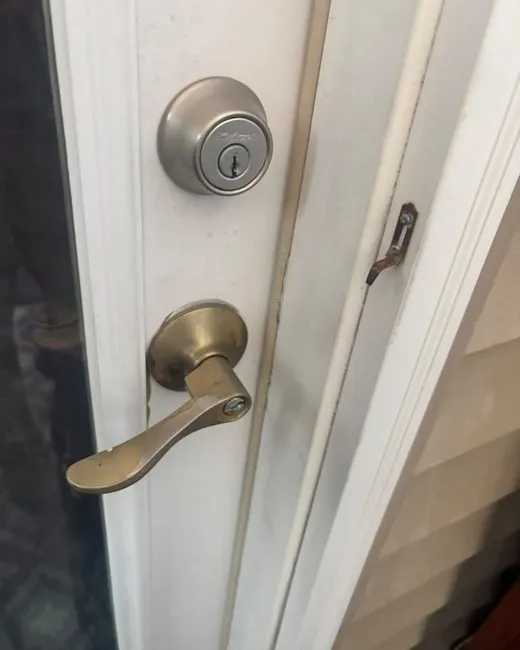
What goes wrong
Locks fail in a few common ways during an emergency: keys break off in the cylinder, a deadbolt won’t retract because the tailpiece won’t engage, the latch binds against a warped door edge, or an electronic keypad loses power and won’t accept codes. We see mortise locks with seized mechanisms, rim cylinders whose screws have sheared, and thumbturns stripped on the inside. In Paoli and nearby towns like Malvern, we deal with these mechanical failures by diagnosing what specifically is sticking or misaligned so we can decide whether to extract, repair, or replace the part.
02
What the job involves
When a key snaps or a thumbturn spins without moving the bolt, the job often starts with careful extraction and inspection of the cylinder and keyway. We use picks, plug spinners, and extraction tools to remove broken key fragments without damaging the plug. If the plug or tailpiece is ruined, we remove the cylinder and recommend a direct swap to a compatible cylinder or a full lockset replacement. For electronic locks we test power, wiring, and the control board before disassembling the lock head to avoid unnecessary replacement.
03
Good to know
While you wait, lock the door you can lock and stay somewhere safe away from the entrance if you feel uneasy. Gather the keys you have, any broken pieces you recovered, and any paperwork that shows ownership or authorization for the lock (property deed, lease, or company ID), so we can confirm you have a right to the lock. Tell us if the door has been forced, if there’s a damaged strike or hinge, and whether the lock is connected to an alarm or smart system. That information speeds up our assessment when we arrive.
04
Worth knowing
We drive out from Havertown and bring a stock of cylinders, deadbolts, screws, long-throw bolts, reinforced strikes, and common electronic replacement modules. If rekeying is the safest option we re-pin cylinders on site, matching the new key to multiple locks when requested. For damaged doors we fit reinforced strike plates and longer screws to tie into the framing, and for broken keys we remove the fragment, test the remaining mechanism, and cut a new key to the extracted profile when possible. We work where the lock is and leave the hardware operating reliably.