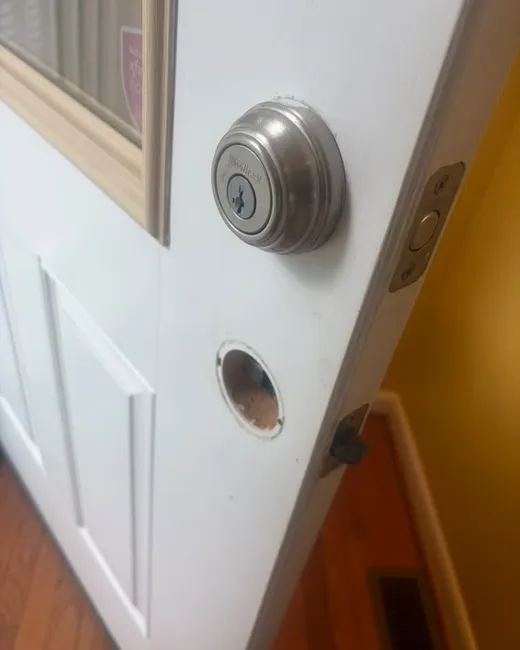
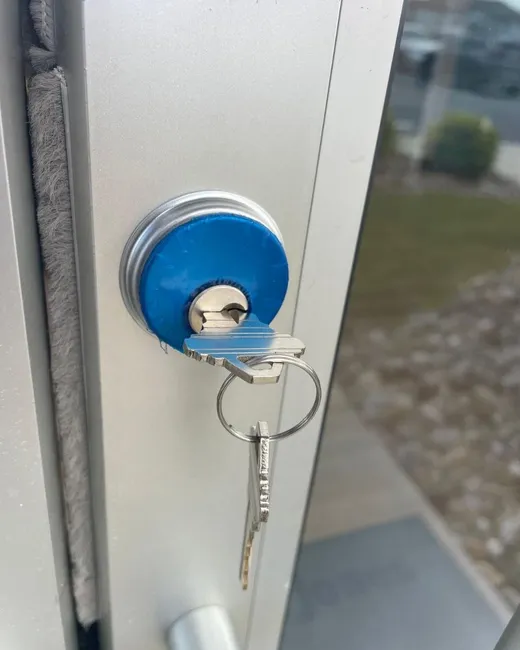
You put the key in, it turns, and the door stays shut. It is one of the most confusing lock problems, because the part you can see seems to be working.
The cylinder, the part the key goes into, only does one job: it turns a small piece behind it that pulls the bolt or the latch back. When the key turns but nothing moves, that connection is usually where the trouble is.
Step 1: Notice how the key feels
How the key behaves tells you a lot about what has failed.
- The key spins all the way around with no resistance: the piece behind the cylinder that moves the bolt has probably broken or come loose.
- The key turns partway and stops hard: the bolt is likely pressing against the strike plate in the frame, or something inside the lock is jammed.
- The key won't turn at all: that is a cylinder problem, which is a different job, often a worn key or a worn cylinder.
Step 2: Take the pressure off the door
Doors move with the seasons. When a door swells or the house settles, the bolt ends up rubbing hard against the edge of the strike plate and the key cannot pull it back.
Push the door firmly toward the frame, or pull it toward you by the handle, and try the key again while you hold it there. If the door opens that way, the lock is fine and the strike needs adjusting.
Step 3: Try it from the other side
If someone is inside, ask them to try the thumbturn. If the thumbturn moves the bolt, the problem is between the outside cylinder and the bolt. If the thumbturn won't move it either, the bolt itself is stuck or the lock body has failed.
Step 4: Don't force it
- Don't grip the key with pliers for extra leverage. Keys snap, and then there are two problems in the same lock.
- Don't spray oil into the lock. It gums up with dust and makes the next failure more likely.
- Don't take the lock apart from the outside. Leave it in one piece so it can be opened cleanly.
What we do when we get there
We come to the door, open it, and find out which part failed: the connection behind the cylinder, the lock body, the latch, or the strike. Then we repair it or replace the part that has worn out, and test the door from both sides before we leave.
If the bolt was binding because the door had shifted, adjusting or reinforcing the strike plate is often all it takes. If the lock itself is worn out, we will say so and show you why.
Signs it was coming
- The key had been getting harder to turn for a while.
- You had to lift or lean on the door to lock it.
- The bolt didn't go all the way out when you locked it.
- The thumbturn or the outside trim had become loose.
Any of those is worth a call before the lock gives out completely, especially on the only door you use.