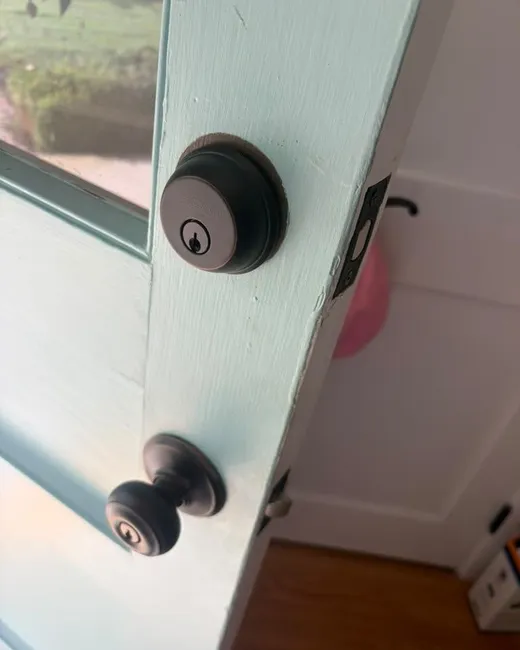
Pennsylvania winters are hard on locks. A key that worked fine in October starts dragging in January, and a car door lock that was rained on in the evening can be frozen solid in the morning.
Here is why it happens and what to do about it, for car locks and house locks alike.
Why locks stick in the cold
- Water gets into the cylinder, from rain, snow or condensation, and freezes around the small pins inside.
- Old household oil thickens in the cold and turns sticky.
- Doors shrink or swell with the weather, so the bolt no longer lines up with the strike.
If your car door lock is frozen
- Try the other doors, and try the remote. Often only one lock is frozen.
- Use a lock de-icer spray made for the job. Many people keep one in the house or the bag rather than in the car, for exactly this reason.
- Warm the key in your hand before trying again. Don't heat it with a lighter: a flame can damage the chip and the plastic head of a modern key.
- Don't pour hot water on the lock or the window. It refreezes quickly and can crack cold glass.
- Press firmly on the door around the handle to break any ice around the seal before pulling.
If your house key is sticking
- Don't force it. A key bent or snapped in a frozen lock is a much bigger problem.
- A lock de-icer works on house cylinders too.
- If the key goes in but won't turn, the bolt may be pressing against the strike. Push or pull the door toward the frame while turning the key.
- If the key drags every time it is cold, the cylinder probably needs cleaning and a proper lubricant.
What to put in a lock, and what not to
Use a dry lubricant made for lock cylinders, the kind based on PTFE, applied in a short burst into the keyway, then work the key in and out a few times.
Avoid household oil sprays: they attract dust and turn into a thick paste in the cold. Graphite is often recommended, but it can cake when it mixes with moisture, so go easy with it in a lock that gets wet.
Getting ahead of it
- Lubricate your locks in the fall, before the first freeze.
- Replace worn keys: a worn key in a cold, stiff lock is the most likely one to snap.
- If a door only locks when you push it, have the strike adjusted before winter makes it worse.
When to call a locksmith
If the key has bent, snapped, or won't go in at all, or the lock turns but the door still won't open, stop and call. A broken key stuck in a frozen cylinder is a common winter problem. We come to you, whether it is the front door or the car in the driveway.